
Jefferson County VINE Coverage
Kentucky VINE means Victim Information and Notification Everyday. It is reached through VINELink or by telephone at 800-511-1670. The service covers Kentucky local jails and adult correctional facilities, with certain juvenile coverage. For Jefferson County, that can include an LMDC record and a separate Kentucky Department of Corrections record.
VINE answers a narrow custody question. A current result supplies location or facility information. When the listed custodian reports that the person is no longer held, the result should state not in custody and give the date released. That confirms departure from that custodian. It does not show why the court authorized release, rule out a transfer, or prove that all supervision ended.
The official Kentucky VINE information describes release status, telephone access, and notification timing. LMDC’s own public roster is labeled Current Inmates, so VINE is especially useful after a person drops off that live list. A durable local check adds the LMDC release transaction and the Jefferson court order.
The VINELink search entry begins with the state selection used for a Kentucky custody check.
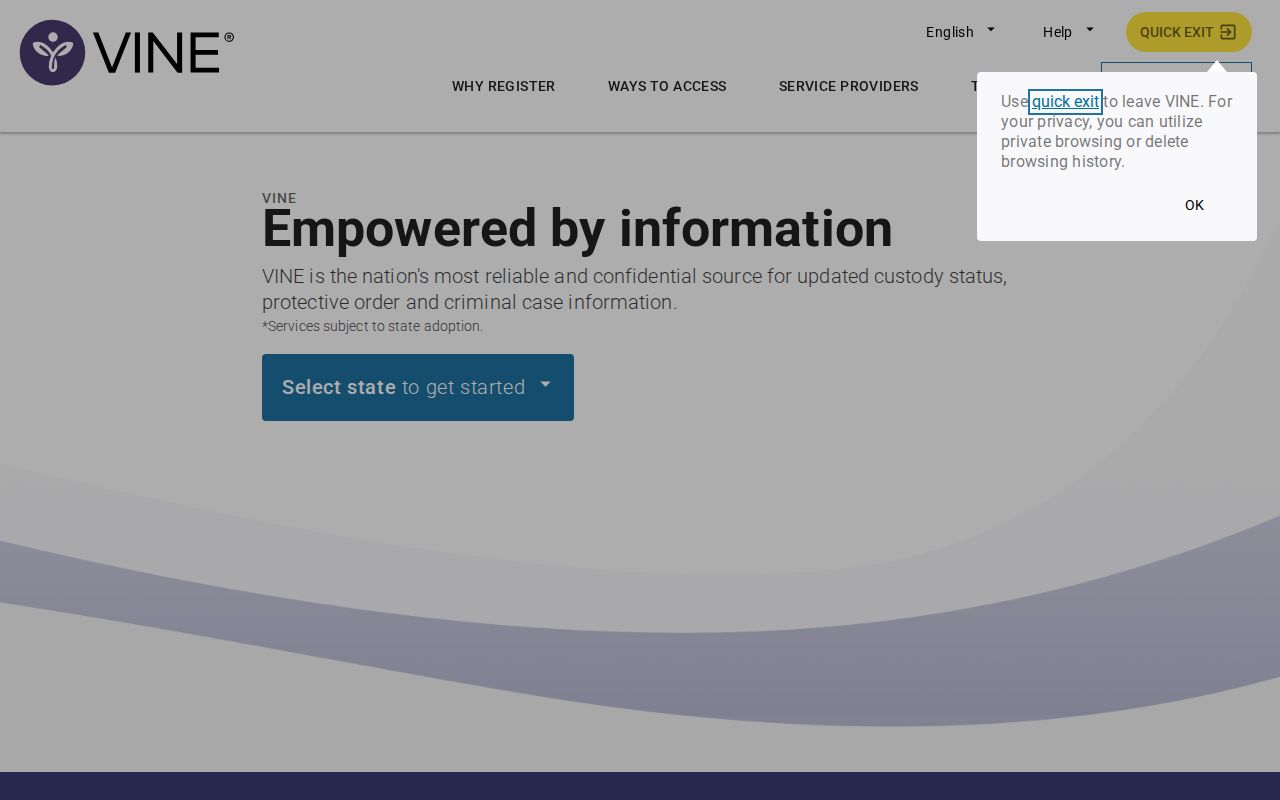
After selecting Kentucky, the offender search and notification choices must be tied to the correct local or state record.
Search Jefferson County VINELink
Use VINELink for one specific identity. Begin with a stable jail or DOC identifier when it is known. A partial name is accepted, but common names and aliases may produce several results. Each matching record must be opened and read in its own agency context.
- Open VINELink and select Kentucky.
- Choose Find an Offender.
- Enter a partial name or the jail or DOC offender ID. Avoid adding uncertain details that could hide the right match.
- Compare the available identifiers and neutral identity fields. Note whether the agency is LMDC, another local jail, or KDOC.
- Open every plausible local and state record. Preserve the exact status, custodian, release date, and time checked.
- If the result says not in custody, continue to the agency release record or court file when the release reason or destination matters.
A negative result is not enough. Spelling, duplicate records, a recent transfer, or feed timing can affect the search. The Jefferson County released-inmate lookup sets out the LMDC, court, KDOC, BOP, and ICE paths when VINE alone cannot resolve the event.
Jefferson County VINE Release Fields
The visible fields depend on the record and status. Copy field labels exactly. Do not turn a projected state date into an actual VINE release date, and do not treat a facility location as a final legal disposition.
| Field | What it establishes |
|---|---|
| Custody status | Whether the listed agency currently reports custody |
| Facility or location | The custodian or placement tied to that record |
| Offender identifier | A key for separating similar names and matching another agency record |
| Date released | The date VINE reports departure from that listed custodian |
| Notification option | The available route to register for a custody-status change |
Release date and release reason are different facts. VINE may supply the first, while an LMDC release sheet or court order supplies the second. A bond release, sentence completion, dismissal, transfer, parole, and detainer handoff should not be merged under one vague label.
- Actual release date
- The recorded custody event, not a forecast.
- Projected release date
- A sentence estimate that can change.
- Transfer
- Departure from one custodian into another custodian’s control.
- Disposition
- The court’s recorded result or order in the case.
Register Jefferson County Release Alerts
Registration must be attached to the correct result. Kentucky offers online contact methods through VINELink and touch-tone telephone registration. The available prompts determine whether phone or email can be used for that event. Kentucky permits two telephone numbers and uses a four-digit PIN for phone notification.
- Open the matched offender result and select Notify Me of Status Changes.
- Choose an available phone or email method and follow the prompts. Recheck the agency and offender identifier before saving.
- For telephone registration, call 800-511-1670 and enter the requested offender and contact information.
- Create and retain the four-digit PIN. When a release call arrives, entering the PIN acknowledges notice and stops repeat calls.
- Keep each contact method current. Re-register when the record or agency changes.
- Check the live status after an alert. The notification is a prompt to verify, not a substitute for direct safety planning or agency confirmation.
For a jail release, calls repeat every 30 minutes for 24 hours or until the PIN acknowledges the message. For state release, Kentucky attempts advance notice 72 hours before release where possible, though some event types cause calls only after release. That advance rule is not a Jefferson County 72-hour release list.
Registration is not disclosed to the inmate. Even so, no automated service can promise perfect timing. Contact data can become stale, an event can change, and an agency feed can lag. Maintain another means of checking status when the timing matters.
Kentucky notification timing depends on the custody system. Repeated jail-release calls are designed to continue until acknowledgment or the stated calling period ends. Advance state-release notice is attempted where possible, but a projected state date can change through sentence recalculation, discipline, parole processing, or a detainer. Some notices therefore arrive only after an event. The correct response to any message is to record its time, identify whether it names LMDC or KDOC, acknowledge it with the PIN when appropriate, and then reopen the matching record for the current status.
Duplicate Jefferson County VINE Records
Kentucky’s duplicate-record warning is crucial in Louisville. One person may have a local LMDC entry and a KDOC entry. The state advises registration on both when both records appear. This can happen because the two systems describe different custodians, not because one entry must be an error.
An LMDC release may be a transfer into the state system. In that sequence, the local record can say not in custody while the KDOC record shows incarceration or another placement. Registering only on the local entry could leave the state custody stage untracked. The reverse issue can arise when an old state record remains searchable while the current event is local.
Record each agency name, ID, and status on its own line. If identifiers conflict, stop the match and ask the relevant custodian to resolve it. Name and county alone are weak proof. A CIN or booking number belongs to the local record, while a DOC or PID number anchors the state record.
A short source log makes duplicate results manageable. Record the spelling searched, the identifier entered, the agency displayed, the check date and time, and the exact status phrase. If the result later changes, keep both observations rather than replacing the first. A dated screenshot should retain enough of the interface to show the source, identifier, and status together. A cropped release date without its custodian can be misread, especially when the same person moved from LMDC into KDOC custody.
Confirm Jefferson County Releases
For an LMDC event, pair the VINE date with the corrections booking and release transaction. The signed Jefferson District or Circuit Court order can explain whether bond, dismissal, sentence, probation, or another action caused the release. If the LMDC transaction names a receiving agency, continue in that system.
For a Kentucky state case, search KOOL and keep current location, supervision status, projected date, parole history, and final discharge separate. KDOC’s date-based Daily Releases archive can supply DOC number, release type, releasing facility, and other state fields. Mandatory reentry supervision or shock probation indicates an exit from incarceration while supervision continues.
VINE is not a federal locator. A federal release belongs in the Bureau of Prisons Inmate Locator. An immigration custody check belongs in ICE’s Online Detainee Locator System. An LMDC disappearance may be a handoff under a detainer, so it should never be restated as proof that the person is free of custody.
| Question | Best next source |
|---|---|
| Did LMDC report a release? | VINE plus the LMDC release transaction |
| Why did the court authorize it? | Jefferson clerk docket and signed order |
| Did state incarceration end? | KOOL and KDOC Daily Releases |
| Did federal custody end? | BOP Inmate Locator |
| Was there an immigration handoff? | ICE ODLS and case records |
Jefferson County VINE Limits
VINE is continuously available, but the underlying agency data still controls what appears. A recent booking, transfer, correction, or release may not post at the same moment as the physical event. Keep the search time and take the exact status wording from the result. Recheck instead of overwriting an earlier observation when the record changes.
The service also does not decide guilt, interpret the court case, calculate a sentence, or prove final discharge. A released result may coexist with parole, probation, mandatory reentry supervision, another warrant, or a transfer. The agency that created the disputed field is the right correction point.
Corrections must be routed by system. LMDC can review its booking and release transaction. KDOC Offender Information Services can address a state offender field, while the Parole Board controls its own decision record. The Jefferson clerk addresses a docket or signed order. VINE support can investigate a feed or notification issue but cannot rewrite the source agency’s legal record. A correction request should include the stable identifier, disputed field, dated observation, supporting order when available, and the specific change requested.
A precise conclusion names the source, custodian, and event. “Kentucky VINE reports release from LMDC on the displayed date” is sounder than a broad claim about every form of custody. That wording preserves what the record proves and leaves other jurisdictions open for confirmation.
Telephone access also remains useful when the web interface is unavailable. Callers should have the correct name or offender identifier ready, listen for the agency attached to the result, and retain the four-digit PIN separately from the public record notes. A phone response carries the same scope limit: it describes the participating custodian’s report, not the full court case or every later placement.